

Villa Carlotta
Via Regina, 2 - 22016 Tremezzina
Tremezzo, Como
Hours
Opening 2024: 22nd March
What's on
The beauty of the camellias announces the spring!
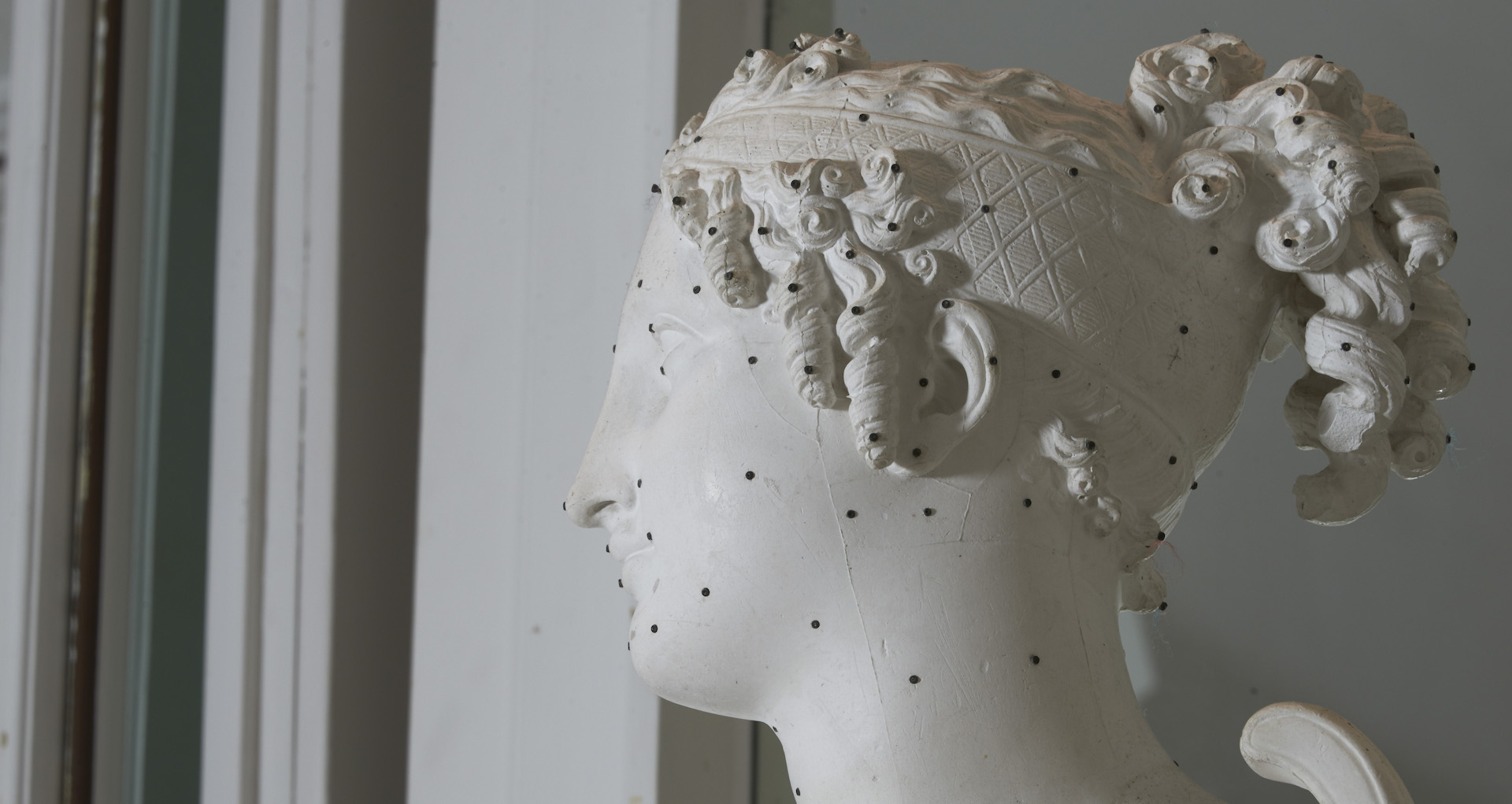
A masterpiece by Antonio Canova – the precious original plaster model of the Muse Terpsichore – is to be found in the Sala dei Gessi. It is an extraordinary work for the sensitive rendering of the sculpted pose and drapery. The figure depicted, Terpsichore, is the muse of dance and choral singing, as suggested by the lyre she holds in her left hand.
In addition to the plaster model of Terpsichore in Villa Carlotta, there is a version cast in plaster to be found in Possagno’s Gypsotheca Museo Canoviana, and then two marble versions: one in the Fondazione Magnani Rocca, in Parma, while the other is a later autograph replica purchased in 1968 by the Cleveland Museum of Art, which Canova made in 1814–16 (signed and dated 1816) for the English collector, Simon Houghton Clarke.

Antonio Canova (Possagno 1757 – Venice 1822) began to make the work in 1808 at the request of the Bonaparte family. The statue was to be a deified portrait of Alexandrine de Bleschamp, wife of Lucien Bonaparte, Napoleon’s younger brother. For reasons still unknown, the commission was acquired by Giovanni Battista Sommariva, who was creating his temple to Neoclassicism at Villa Carlotta (then Villa Sommariva). He bought and commissioned works of art from the most important artists of the time, including Antonio Canova. At the request of the new client and patron, Canova idealized the face and features, which are no longer those of Alexandrine de Bleschamp.
Canova and Sommariva established a relationship of mutual esteem and trust, and Terpsichore was one of his favourites of the many works purchased and commissioned by the collector from the artist.
The obsessive love of this sculpture was so strong that Sommariva not only bought the marble statue (which was exhibited in his Parisian mansion), but also the plaster model to ensure no other copies of the work were made.
Sommariva wrote to Canova on 31 March 1813, emphatically defining the sculpture “my bride”. Ardently desired and sought by the patron, on its arrival in Sommariva’s Parisian house, the statue was placed at the foot of his bed, satisfying the taste for sensuality typical of the nineteenth century: the aristocracy and the rising bourgeoisie, were not able to appreciate the naked female form openly so they surrounded themselves with works of art with strong erotic overtones, justified and camouflaged as nudity typical of classical works or of the emerging Eastern preference.

The peculiarity of the plaster exhibited at Villa Carlotta is that it still bears intact the markers: traces of the creative process with which Canova breathed life into his masterpieces. The artist would organize his activity rigorously so as to have every stage of the work under control. From the clay model that embodied a first idea of the work – often from preparatory drawings – he proceeded to make a life-size clay model.
This came about by making a supporting framework comprising an iron rod (the same height as the finished work), connected to smaller metal rods fitted with wooden crosses at the tips. In this way, Canova could judge the general effect of his work before starting to sculpt. The transition from the clay to the plaster was achieved using the lost cast technique: the clay model was covered with a light layer of reddish gypsum and then with a further layer of white plaster which hardened to form an outright cast. Detached from the clay model, the cast was again filled with plaster to create a new three-dimensional model.
As soon as the plaster hardened enough to allow it, the external cast was destroyed, taking great care when the reddish plaster appeared. Markers were then inserted into the gypsum model thus obtained: iron nails that were used by the students as reference points and allowed transfer of plaster measurements to the marble block to proceed with roughing.
The work was then ready for what Canova himself called the final hand: a stage of the process reserved for the master himself. He is said to have worked by candlelight to guarantee perfect rendering of volumes and shadows. Others argue that the master worked by listening to ancient texts, such as the Odyssey, spoken aloud by helpers hired for the task.
To make his statues even more realistic, Antonio Canova would spread a special patina on the epidermis areas to suggest the softness of skin. Made with several different materials, of which only rare traces remain, the patina was also to safeguard against the effects of time, ensuring a sort of perennial harmony to the work.
Home / The museum / The Hall of the plaster models / The Muse Terpsichore by Antonio Canova